
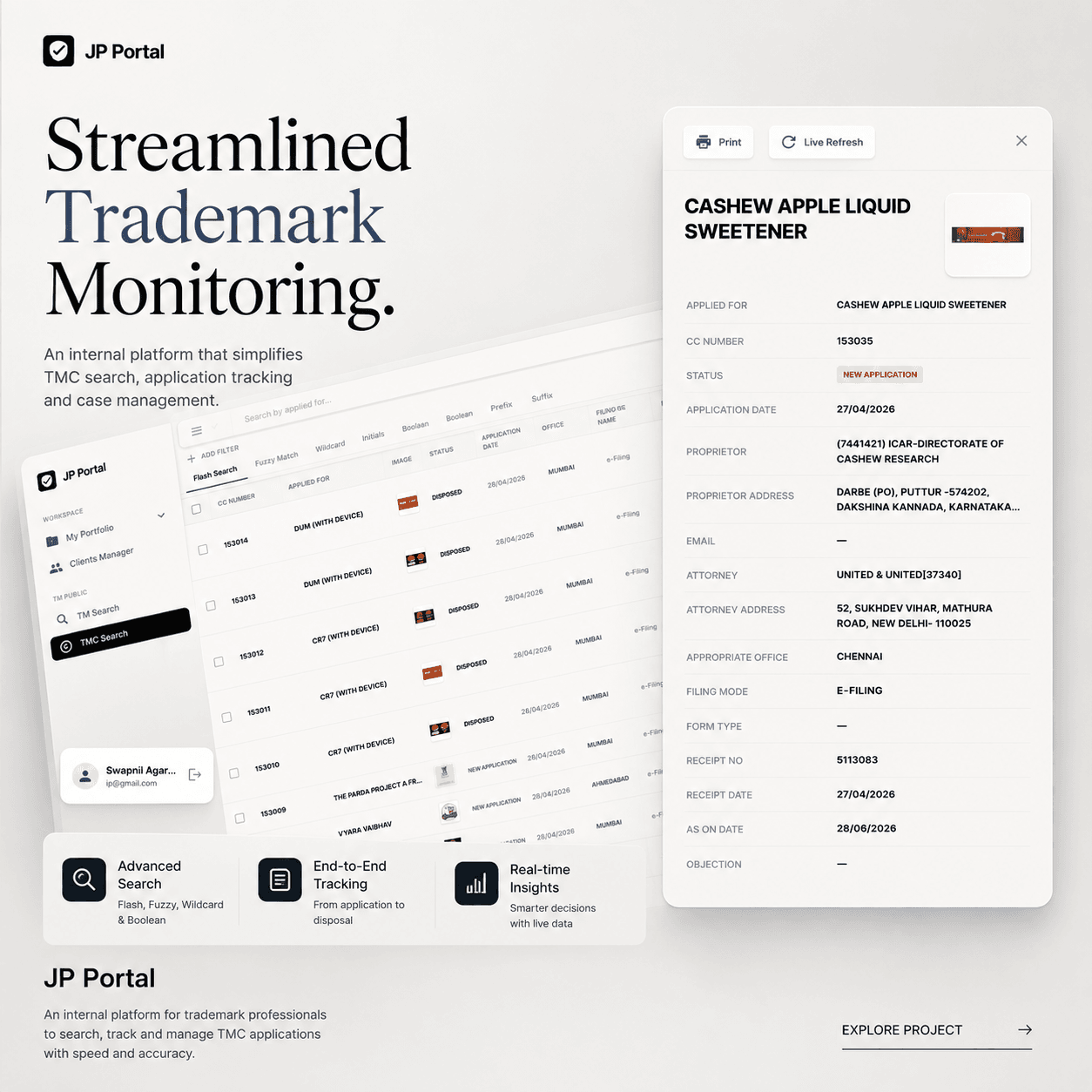
Overview
JP Associates is a commercial-grade trademark and copyright intelligence platform built for a Gwalior law firm. It continuously collects, structures and monitors more than 70 lakh statutory records, turning fragmented government-registry data into one dependable workspace for discovery, surveillance, deadline management and client reporting.
The challenge
Official trademark and copyright registries hold critical statutory data, but their infrastructure creates serious operational bottlenecks for IP law firms and brand owners.
- Hostile and fragile registries: Dynamic session tokens, aggressive IP rate limiting and complex captchas prevent standard programmatic queries and native bulk synchronization.
- Flawed keyword-only queries: Basic searches miss deceptive infringement tactics such as sound-alike spellings, partial-string clones and visual typos across Nice classification codes.
- Strict statutory opposition windows: Once an application is gazetted, attorneys typically have only three to four months to file a formal opposition. Manually tracking publications across 45 classes risks missed deadlines and irreversible brand dilution.
- Fragmented portfolio management: Legal teams manage client portfolios across disconnected spreadsheets without centralized docketing, dynamic milestone tracking or rapid reporting.
Our solution
We designed one unified platform that combines continuous background ingestion, phonetic and fuzzy discovery, and an interactive real-time portfolio dashboard.
- Autonomous 24/7 ingestion engine: A persistent crawler network polls TM and TMC registries around the clock, handles changing portal sessions and indexes newly filed applications and status transitions.
- Live delta sync and visual updates: Incoming registry snapshots are compared with stored records. Legal movements—including Objected, Marked for Exam, Advertised and Awaiting Hearing—update dashboard badges and stage timelines through WebSockets.
- Phonetic and fuzzy trademark watch: Elasticsearch similarity scoring detects sound-alikes, typographical variants and visual brand clones as they are published.
- Multi-tenant portfolio workspace: Legal teams can segment thousands of marks by client, automate statutory deadline calendars and generate bulk PDF and Excel exports.
Tools used
- Scraping and automation pipeline: Python, Playwright for headless browser automation and session handling, Beautiful Soup for DOM extraction and normalization, OCR/captcha-processing services and rotating proxy management.
- Backend architecture and APIs: Node.js REST services, asynchronous job scheduling and delta-evaluation pipelines.
- Real-time streaming: WebSockets and Socket.io push status transitions, notification toasts and timeline changes directly to active dashboards.
- Search and similarity engine: Elasticsearch with Double Metaphone phonetic analyzers, Levenshtein edit distance and Edge N-grams.
- Database and persistence: MongoDB document schemas store statutory filings, status histories, class descriptors, multi-tenant portfolios and audit logs.
- Frontend platform: React.js powers responsive data grids, stage visualizers, live-status badges and multi-parameter filters.
Results achieved
- Full-funnel automation: Discovery, continuous ingestion, status-change detection and portfolio reporting now operate in one platform, eliminating manual spreadsheet docketing.
- Real-time visual state updates: Official registry changes appear in seconds through WebSockets without requiring a page reload.
- Protection of opposition deadlines: Continuous surveillance alerts attorneys to conflicting and phonetically similar applications as they are gazetted.
- Sub-100ms indexed search: Trademark discovery and similarity checks across the multi-million-record dataset return nearly instantly instead of inheriting government-portal latency.
- 95% reduction in administrative overhead: Automated journal monitoring, client grouping, conflict identification and formatted reporting save dozens of legal-team hours each week.
End of case study